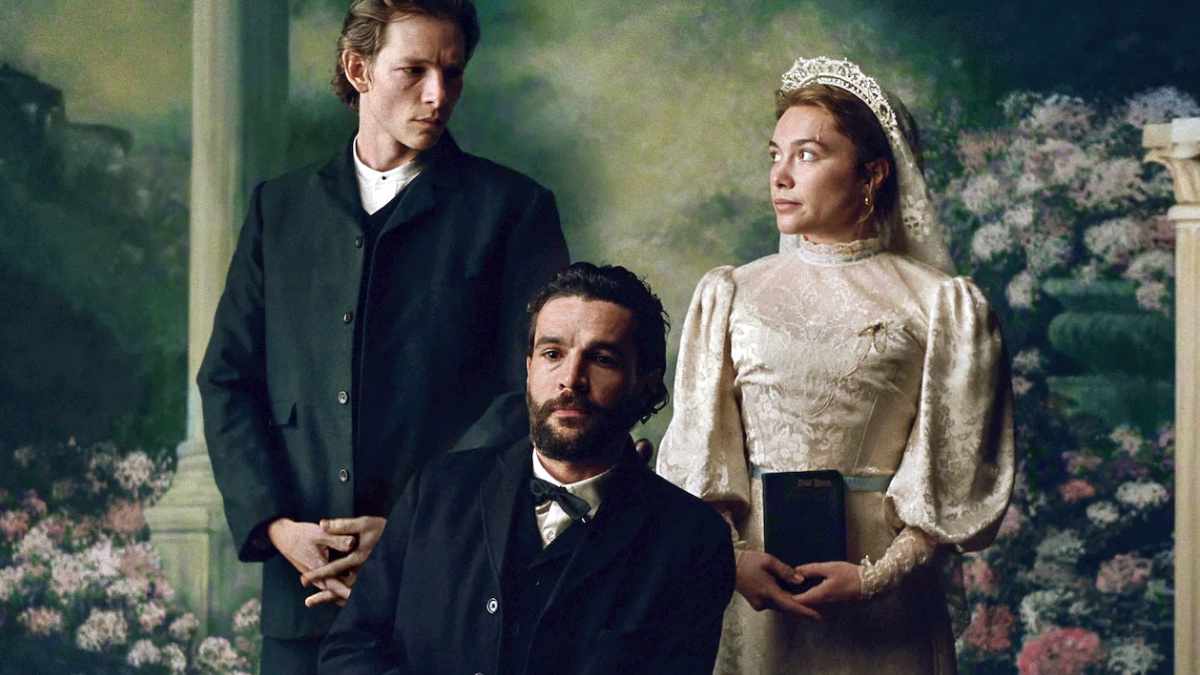
Netflix’s East of Eden takes on one of John Steinbeck’s most demanding works with a seven-part adaptation that is less interested in reproducing every detail of the novel than in finding its own way into the story. At the heart of the series are family, inherited expectations, damaged relationships and the difficult question of whether people are shaped by their nature or by the circumstances around them.
.jpg)
.jpg)
Image source: Netflix (East of Eden)
Showrunner Zoe Kazan approaches Steinbeck’s material with considerable sympathy for its characters, particularly Cathy Ames. Rather than presenting her simply as a figure of evil, the series spends more time examining the experiences that shaped her and the choices she makes in response to them.
The result is a deliberately expansive drama that treats its characters as products of complicated relationships rather than symbols in a straightforward battle between good and evil.
A Story Built Around Family Conflict
The story unfolds across generations, following the Trask family and the tensions that develop between brothers Adam and Charles.
Their father, Cyrus Trask, is a Civil War veteran whose rigid worldview has a lasting effect on his sons. Adam grows into a sensitive and idealistic man, while Charles becomes more suspicious and aggressive. Their differences are important, but the series avoids reducing their relationship to a simple Cain-and-Abel comparison.
The brothers' relationship develops over time, and the different actors portraying them at various ages help establish that continuity. Childhood experiences continue to influence the adult versions of Adam and Charles, giving their eventual conflict a stronger emotional foundation.
Christopher Abbott plays the older Adam, while Mike Faist takes on Charles. Their performances work partly because the characters are not treated as fixed personalities. Their behavior is connected to the expectations placed upon them, especially by their father.
Tracy Letts also makes a strong impression as Cyrus, whose influence becomes increasingly important as the story develops.
Florence Pugh Gives Cathy a More Complicated Identity
.jpg)
Image source: Netflix (East of Eden)
Cathy Ames is arguably the most challenging character in the adaptation, and the series makes her central to its interpretation of Steinbeck's story.
Florence Pugh plays Cathy as someone whose outward behavior cannot always be separated from the experiences that shaped her. The series gives considerably more attention to her childhood and trauma, creating space to understand her without excusing the harm she causes.
That distinction is important.
The adaptation does not simply turn Cathy into a misunderstood victim. Instead, it examines how she responds to what has happened to her. Her ability to recognize the vulnerabilities of other people becomes one of the most unsettling aspects of her character.
Pugh's performance benefits from that uncertainty. Cathy can appear sincere and deceptive within the same emotional space, making it difficult to determine exactly what she believes or feels. Her character doesn't undergo a conventional transformation, but the performance still gives her progression and variation over time.
The younger version of Cathy, played by Vaughan Reilly, is equally important. Her portrayal helps establish the emotional foundations of the character before the story moves toward the adult Cathy.
Adam and Charles Are More Than a Biblical Parallel
.jpg)
Image source: Netflix (East of Eden)
Steinbeck's story naturally invites comparisons between Adam and Charles and the biblical figures of Cain and Abel. The Netflix adaptation uses that framework but doesn't allow it to completely define the brothers.
Adam's apparent goodness is repeatedly complicated by his own behavior. As he becomes older, the qualities he believes separate him from his father begin to look less certain. His idea of himself as emotionally mature becomes increasingly questionable.
Charles, meanwhile, is not simply portrayed as an embodiment of violence or jealousy. His resentment has roots in the family structure surrounding him, particularly in the inconsistent relationship he has with Cyrus.
The performances from Abbott and Faist make this contrast particularly effective. Their characters feel connected even when they occupy opposite emotional positions, which gives their conflict a sense of history rather than making it feel like a predetermined rivalry.
The younger actors portraying the brothers also receive meaningful space. Their work establishes the emotional patterns that the adult performances later continue.
The Series Gives Its Supporting Characters More Space
One of the adaptation's more noticeable strengths is the additional attention given to characters who could easily have remained on the edges of the central family story.
Martha Plimpton brings warmth and complexity to Faye, the madame, while Hoon Lee's Lee becomes an important emotional presence within the larger narrative.
Lee in particular benefits from the series' willingness to give supporting characters room to exist beyond their immediate function in the plot. His relationship with the Trask family contributes some of the show's strongest emotional moments.
This broader characterization also reinforces Kazan's approach to the material. Rather than treating the story solely as a battle between its central characters, the series considers the lives and experiences of people surrounding them.
A Modern Perspective on Steinbeck's Cathy
The treatment of Cathy represents one of the clearest ways in which the adaptation establishes its own identity.
Steinbeck's original portrayal reflects the attitudes and gender expectations of its era. Kazan's version revisits those ideas through a contemporary perspective, particularly in the way it considers Cathy's relationship with sexuality and manipulation.
The series doesn't erase the darker dimensions of the character. Instead, it adds context around them.
That approach makes Cathy's actions uncomfortable for a different reason: the audience is given enough access to her history to understand where some of her behavior comes from while still being confronted by the damage she causes.
It is a difficult balance, and Pugh's performance carries much of that responsibility.
The Final Chapters Face a Difficult Comparison
.jpg)
Image source: Netflix (East of Eden)
The adaptation is strongest when it has space to develop its characters across time. The final two episodes, however, face a particularly difficult challenge as the story moves toward Adam's son Caleb and his coming-of-age.
Joseph Zada gives the role a notable performance, but this section inevitably invites comparison with the 1955 film adaptation directed by Elia Kazan. That earlier version featured James Dean as Caleb, making the role particularly difficult territory for any new interpretation.
The Netflix series cannot completely escape that comparison, especially because of the historical connection between the earlier adaptation and the newer one.
As a result, the closing portion of the miniseries does not have quite the same impact as some of its earlier material.
Cinematic Scale Without Losing Character
Despite its large historical and generational scope, East of Eden remains primarily interested in people.
The production gives the story a cinematic visual quality, but the filmmaking does not overwhelm the performances. That balance matters because the adaptation depends heavily on gradual character development rather than spectacle.
The seven-episode format also gives Kazan room to reorganize the novel's material. Instead of attempting to reproduce every part of Steinbeck's expansive narrative, the series selects and develops particular stories within the larger family history.
This makes the adaptation feel designed for television rather than like a condensed version of the book.
Verdict: An Interpretation Rather Than a Replica
Netflix's East of Eden works best when viewed as an interpretation of Steinbeck rather than an attempt to create a definitive screen reproduction of the novel.
Its most interesting choice is its willingness to reconsider characters who have traditionally been understood in simpler terms, especially Cathy. Florence Pugh's performance gives that decision considerable weight, while Christopher Abbott and Mike Faist bring complexity to the central brotherly conflict.
The series is not equally effective throughout. Its later Caleb-focused chapters have to contend with the legacy of the 1955 film, and that comparison exposes some of the limitations of the new adaptation.
Even so, Zoe Kazan's version has a clear perspective of its own. It preserves the central questions surrounding family, morality and inherited expectations while giving its characters more psychological and emotional space.
Rather than attempting to settle the meaning of Steinbeck's story, East of Eden opens it up again for a contemporary audience.


